
Most visitors make the same mistake with Angkor Thom. They treat it as a stop on the way to Bayon rather than understanding what it actually is. Angkor Thom is not a temple. It is a city. The largest city in the Khmer Empire and, at its peak in the 12th century, one of the largest cities in the world with a population estimated at nearly one million people. The temples inside it are remarkable. The city itself is what gives them meaning.
Built by King Jayavarman VII following the sacking of the previous Khmer capital by the Chams in 1177, Angkor Thom became the last great capital of the empire. It covers nine square kilometres, surrounded by an eight-metre-high laterite wall stretching 12 kilometres, and a 100-metre-wide moat. Five monumental gates pierce the walls, each topped with four giant stone faces gazing in the cardinal directions. The Bayon temple sits at the exact geometric centre of the city, equidistant from each gate. The precision of the layout is not accidental. Every element was deliberate.
Unlike the Hindu temples that preceded it, Angkor Thom was dedicated to Mahayana Buddhism, reflecting Jayavarman VII’s personal faith and his decision to convert the Khmer people. He was also one of the most prolific builders in Khmer history, constructing hospitals, roads, and rest houses across the empire alongside the temples and monuments of the city.
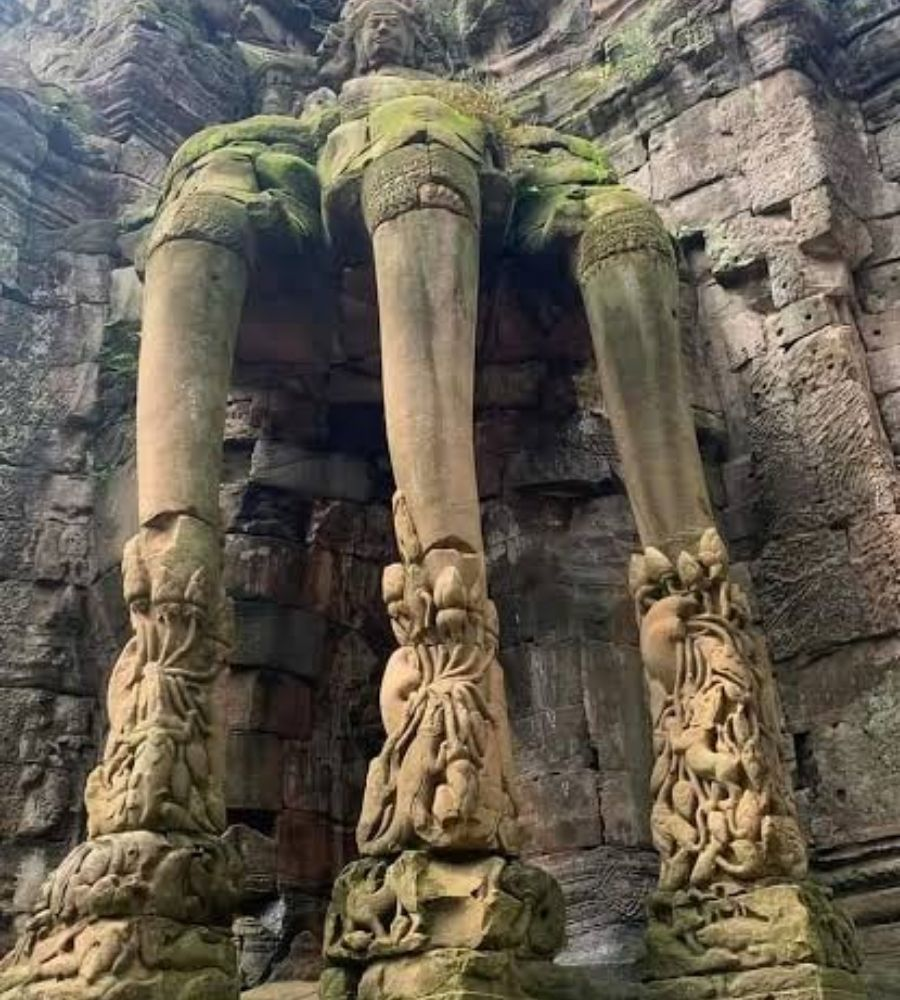
The South Gate
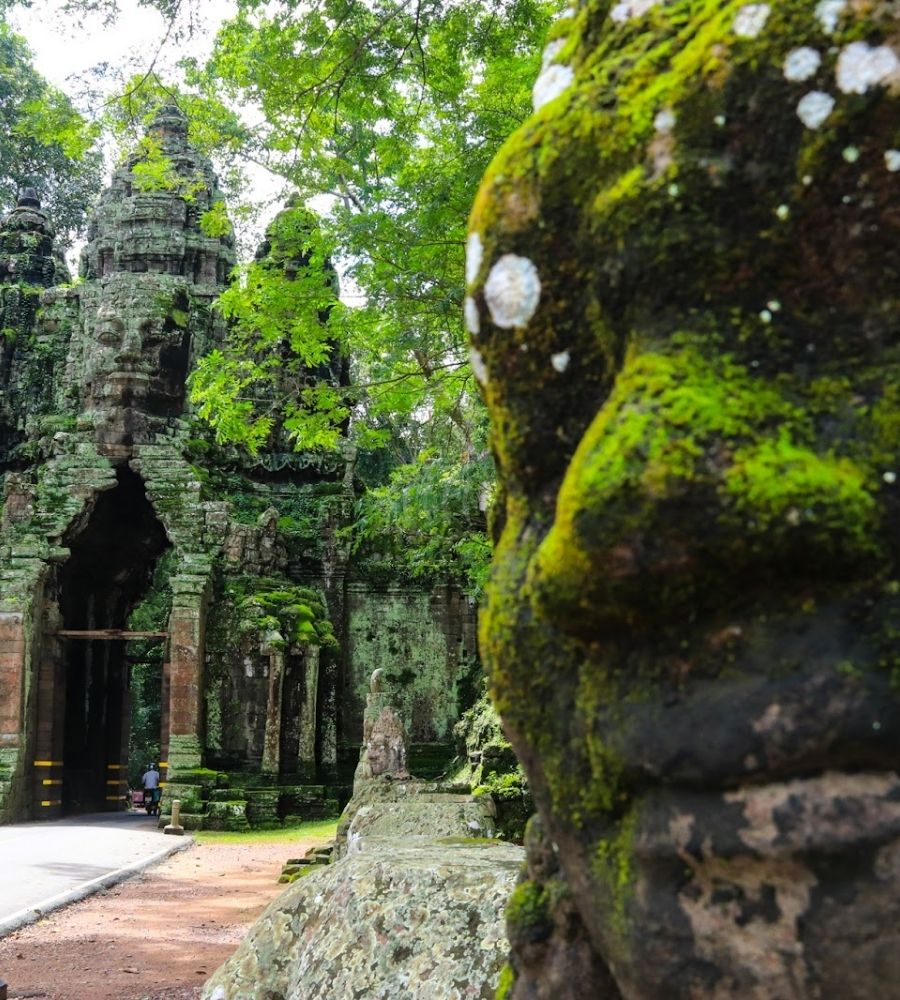
The standard entry point for visitors on the Small Circuit and the most photographed of the five gates. A causeway stretching across the moat is lined on each side by 54 stone figures, gods on the left and demons on the right, each holding the body of a giant naga serpent in a scene representing the Hindu myth of the Churning of the Ocean of Milk. Many of the heads are restorations, as originals were stolen or damaged over the centuries, but the scale and drama of the approach is still extraordinary. Stop here rather than passing through quickly. It rewards attention.
The North Gate is significantly less visited and worth seeking out if you have time. Less restored, more weathered, and usually empty of other visitors.
What to See Inside
Bayon: The centrepiece of Angkor Thom and one of the most arresting temples in the entire complex. 54 towers bearing 216 giant stone faces gaze outward in every direction, believed to represent a fusion of the bodhisattva Lokeshvara and King Jayavarman VII himself, watching over his people and his kingdom. From a distance the temple appears almost chaotic. As you move closer and into it, the faces begin to reveal themselves from every angle, appearing and disappearing as you move through the galleries and towers. The lower galleries contain some of the most vivid and human bas-reliefs at Angkor, depicting not gods and mythological battles but everyday life in the 12th century Khmer Empire: market scenes, fishing, cockfights, military processions. Allow at least an hour. More if the crowds permit slow looking.
Baphuon: An 11th century pyramid temple-mountain dedicated to Shiva, 200 metres west of Bayon. One of the most remarkable restoration stories in archaeological history. The temple was almost completely dismantled by French archaeologists in the 20th century for study and reassembly, with every stone catalogued. When the Khmer Rouge destroyed the records during the civil war, the restorers were left with thousands of unmarked stones and an incomplete puzzle. The reconstruction took decades and was finally completed in 2011. Walking up the long elevated causeway to the temple and knowing this history changes how you look at it. On the west face of the upper level, a giant reclining Buddha was constructed into the stonework during the 15th century conversion of the temple to Buddhism, reusing the original sandstone blocks to create a figure 70 metres long. It is easy to miss if you do not know to look for it.
The Terrace of the Elephants: A 350-metre-long platform running along the eastern edge of the Royal Palace area, its base carved with life-size elephants, garudas, and mythological figures. Originally used as a viewing platform for royal ceremonies and military parades. The carvings at ground level are detailed and well preserved. Easy to walk along and often less crowded than Bayon.
The Terrace of the Leper King: Adjacent to the Elephant Terrace and named for a moss-covered statue found here, now housed in the National Museum in Phnom Penh. The outer terrace walls are carved with dense registers of figures including nagas, garudas, and seated figures heavy with jewellery and headdresses. What most visitors do not know is that there is a second inner terrace running directly behind the outer wall, accessible through a narrow passage at the north end. Walking into it feels like stepping into somewhere you are not supposed to be. The inner walls are carved with the same density and quality as the outer face but have been protected from the elements for centuries. The figures are sharper, the detail more vivid. It is one of the genuine surprises of the entire complex and takes less than ten minutes to walk through. Do not miss it.
Phimeanakas: A small Hindu pyramid temple inside the former Royal Palace enclosure, built in the late 10th century. Legend holds that a serpent lived at the top and each night took the form of a woman. The king was required to sleep with her before joining his wives or calamity would befall the kingdom. The temple is climbable and the view from the upper level across the Royal Palace enclosure is one of the quieter elevated perspectives in the complex, with almost none of the crowds you find at the Bakan tower in Angkor Wat. The surrounding area, including the royal ponds, is peaceful and largely bypassed by tour groups.
Preah Palilay: A small jungle-surrounded temple north of the Royal Palace, quiet and heavily shaded. One of the better places in Angkor Thom to sit for a few minutes away from the main circuit. Monks are often present.
What to Skip or Spend Less Time On
The Prasat Suor Prat towers, twelve nearly identical laterite towers along the eastern edge of the central square, are historically interesting but visually unremarkable. A quick look is enough. The various smaller structures scattered around the northern part of the city are worth exploring only if you have a full day here and genuine curiosity about the detail.
Practical Information
Angkor Thom is included in the Angkor Pass. No separate ticket required.
Most temples inside open at 7.30am and close at 5.30pm. The walls and gates can be visited at any time but walking the full perimeter is best done early in the morning before the heat builds. The southwest corner of the wall, overlooking the moat, is a noted sunset spot accessible outside standard temple hours.
If you are on a multi-day pass, consider arriving at the South Gate at 7.30am before the Angkor Wat sunrise crowd disperses and moves north. The window between 7.30am and 9am gives you the whole complex in relative quiet.
Allow a minimum of three hours for the key sites. A full day if you want to explore properly.
Getting there from Angkor Wat takes around five minutes by tuk-tuk. Most tuk-tuk drivers who cover the Small Circuit will route through Angkor Thom automatically.
Food and drink stalls with English menus are available opposite the Terrace of Elephants. Toilets are located nearby.
A guide makes a significant difference here. The density of history, symbolism, and interconnected stories across the different sites within Angkor Thom is difficult to navigate without context. See the guide recommendations in our Temples listings on SiemReapLife.com.