
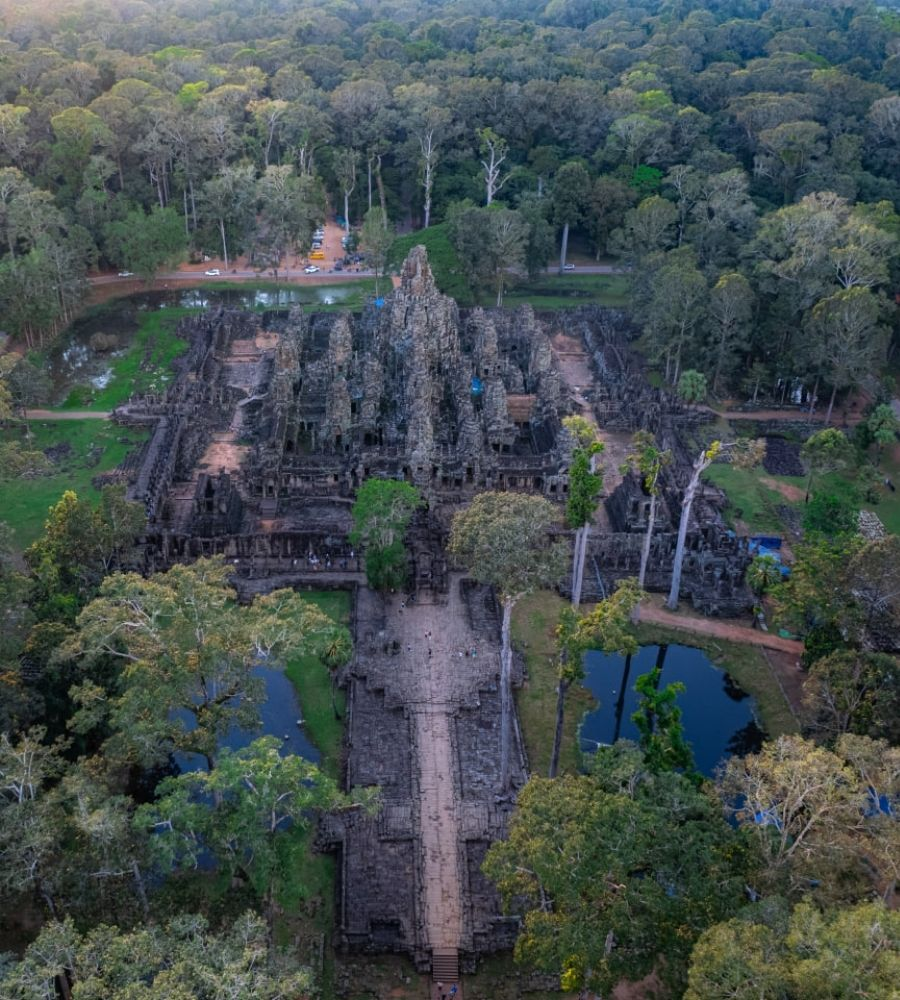
Most people come away from Bayon saying it was their favourite temple in the whole complex. Not Angkor Wat. Bayon. That is worth knowing before you go, because from a distance it does not look like much. The towers appear compressed, almost chaotic, stacked against each other without the grand symmetry of Angkor Wat. It is only as you move closer and then into it that the temple reveals itself, and by then most visitors understand why it is considered one of the most extraordinary buildings on earth.
Bayon was built in the late 12th or early 13th century by King Jayavarman VII as the state temple of his new capital Angkor Thom. It sits at the exact geometric centre of the city, 1.5 kilometres from each of the four main gates. It was the last state temple built at Angkor and the only one built primarily as a Buddhist shrine. Its original name was Jayagiri, meaning Victory Mountain.
The temple was altered by Jayavarman VIII, who briefly restored Hinduism after Jayavarman VII’s death and removed or destroyed many of the Buddhist images. It was later reconverted to Theravada Buddhism, which it remains today. The result of these successive changes is a building that contains overlapping layers of religious iconography from different eras, dense and complex in ways that reward slow looking and a good guide.
The Faces
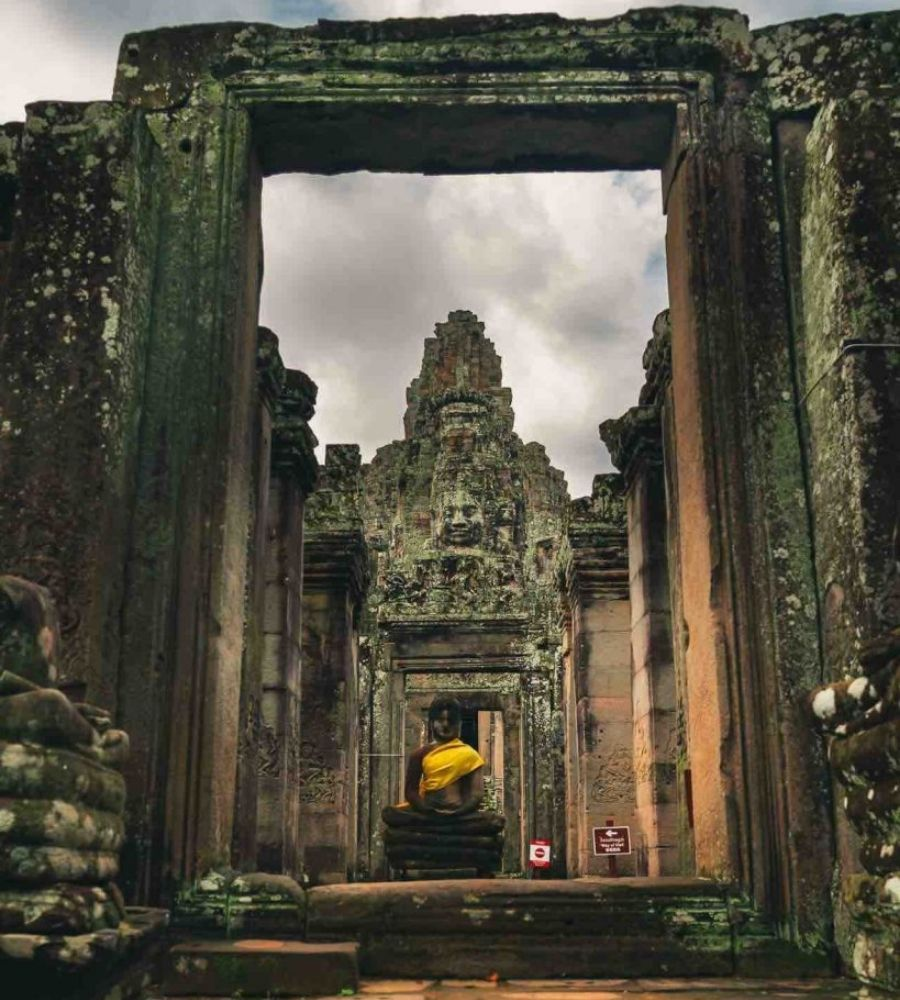
The defining feature of Bayon is its towers, each bearing four giant stone faces gazing outward to the cardinal directions. Today 37 towers remain with 173 faces visible, though the temple originally had more. The identity of the faces has been debated by scholars for over a century. The most widely accepted theory is that they represent the bodhisattva Lokeshvara, the embodiment of compassion, fused with the features of Jayavarman VII himself, presenting the king as a divine and all-seeing ruler watching over his empire in every direction. Some Cambodians believe the faces represent Brahma, given their four-sided symmetry. The original central statue of the Buddha, 3.6 metres tall, was removed from the sanctuary and destroyed during the Hindu restoration. It was recovered from the bottom of a well in 1933, pieced back together, and is now displayed in a small pavilion within the temple grounds.
What to See
Bayon is built across three levels. The first two are square galleries lined with bas-reliefs. The upper terrace is dominated by the face towers.
The outer gallery bas-reliefs are unlike anything at Angkor Wat. Where Angkor Wat depicts Hindu mythology and epic battles between gods, Bayon’s outer gallery shows the real world of 12th century Cambodia. Markets with traders and customers. Fishing boats on the Tonle Sap. Cockfights. Women giving birth. A naval battle between the Khmer and the Cham. Circus performers. These panels are one of the most vivid records of daily life in the ancient world anywhere on earth and most visitors walk past them too quickly. Slow down here.
The inner gallery on the second level contains more religious scenes and is less visited than the outer gallery. Worth moving through carefully.
The upper terrace is where the experience shifts entirely. You leave the worldly scenes below and enter the face towers directly, moving through narrow passages with the giant carved faces appearing at eye level from every angle. The light changes constantly depending on time of day. Early morning and late afternoon produce the most dramatic shadows across the stone. Midday flattens everything. Come twice if you can.
The Original Buddha Statue
Worth finding before you leave. A small pavilion near the temple houses the reconstructed statue of the seated Buddha that once occupied the central sanctuary. It was smashed during the Hindu restoration under Jayavarman VIII, recovered from a well in 1933, and painstakingly reassembled. Most visitors miss it entirely.
Practical Information
Bayon is included in the Angkor Pass. No separate ticket required. Open 7.30am to 5.30pm.
Allow at least one hour. Two if the crowds allow you to move at your own pace. There is more shade inside Bayon than at most Angkor temples, making it more tolerable at midday than open sites like Angkor Wat. That said, early morning and late afternoon remain the best times for both light and crowd levels.
Bayon is the centrepiece of the Small Circuit and easily reached from Angkor Wat in around five minutes by tuk-tuk via the South Gate of Angkor Thom.
A guide makes a significant difference here. The layers of history, the identity of the faces, the bas-relief narratives, and the religious shifts the temple went through are all but invisible without context. See guide recommendations in our Temples listings on SiemReapLife.com.