
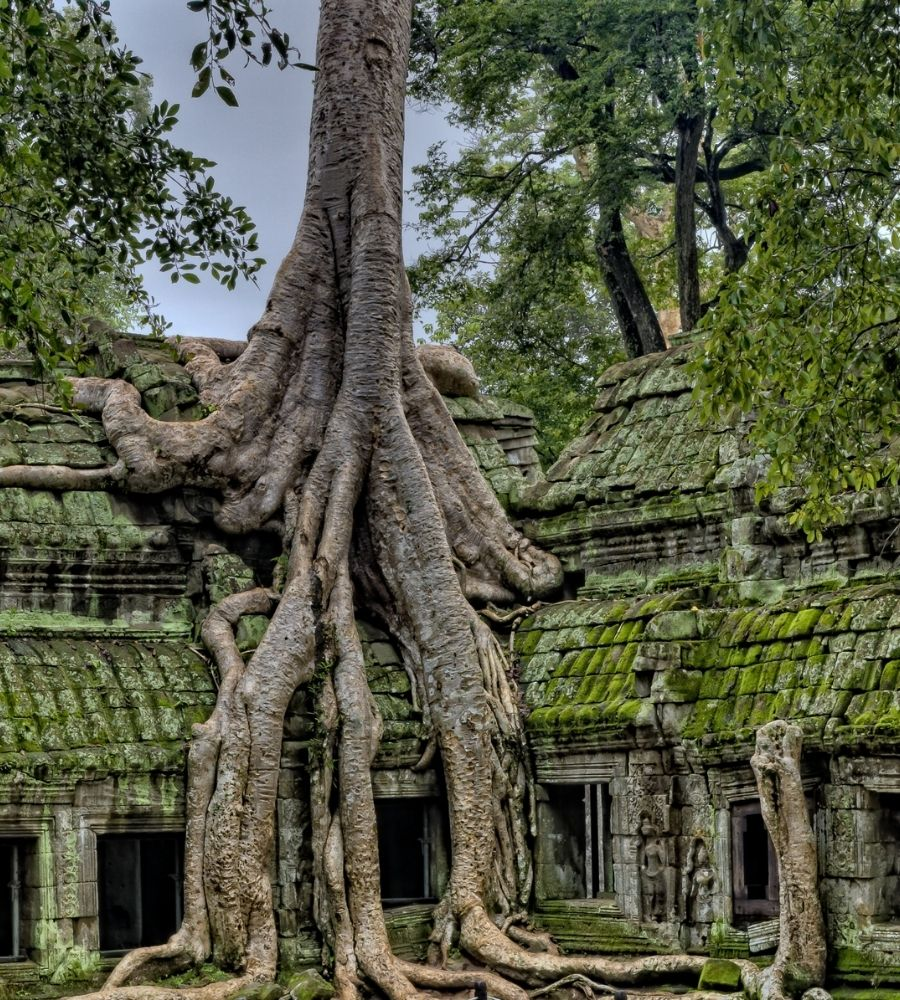
Ta Prohm is the temple the jungle took back. While the rest of Angkor was cleared, consolidated, and restored over the 20th century, Ta Prohm was left largely as it was found, with massive silk cotton and strangler fig trees growing directly through the stonework, their roots splitting walls and lifting towers. The decision was deliberate. The result is the most visually arresting ruin in the complex and, on a quiet morning before the tour groups arrive, one of the most atmospheric places in Southeast Asia.
Most people know it as the Tomb Raider temple. The 2001 Lara Croft film was partly shot here. That association brings crowds. Come early or come late.
Ta Prohm was built by King Jayavarman VII in 1186, originally as a Buddhist monastery and university. A stone inscription found at the site records that at its peak it housed over 12,500 people including 18 high priests, 2,740 officials, 2,202 assistants, and 615 female dancers. It was one of the wealthiest and most important religious institutions in the empire. Its original name was Rajavihara, meaning Royal Monastery.
How to Visit
Ta Prohm gets extremely crowded between 9am and 3pm. The tour groups move through in a predictable direction, entering from the west and exiting east. Going against the flow, entering from the east and moving west, puts you moving through quieter sections while the crowds are concentrated elsewhere. Ask your tuk-tuk driver to drop you at the east entrance. This single decision makes a significant difference to the experience.
What to See
The temple is built on a single level, which makes it easier to navigate than the multi-tiered structures of Angkor Wat or Bayon, but the layout is deliberately labyrinthine. Galleries lead into courtyards that lead into further galleries. It is easy to get turned around, which is part of the experience.
The trees are the main event and they are genuinely astonishing. The silk cotton trees in particular grow to enormous size, their roots cascading down over stone walls and doorways in curtains of pale wood. The strangler figs work differently, sending roots downward from above and slowly encasing whatever they grow over. The interplay between the organic and the built is unlike anything else in the complex. Resist the urge to photograph only the famous spots. The less visited corners of the outer galleries have some of the most dramatic tree-root interactions in the whole site.
The Hall of Dancers near the eastern entrance is worth finding. The walls are carved with rows of apsara figures, celestial dancers, in a style distinguished by the extraordinary detail of their jewellery, headdresses, and hand positions, each gesture carrying specific symbolic meaning in classical Khmer dance tradition. Many have been damaged but enough remain to understand what the complete decoration would have looked like.
The so-called Tomb Raider tree, a large silk cotton growing over a collapsed gallery near the centre of the temple, is the most photographed spot. There will be a queue for photos during peak hours. If you want it without people, arrive at 7.30am when the temple opens and go directly there.
What to Know Before You Go
The paths can be uneven and some areas involve climbing over or ducking under fallen stones. Comfortable closed shoes are more practical here than sandals.
The trees are extraordinary but the temple is also being slowly destroyed by them. Conservation teams work continuously to manage the balance between preservation and the organic growth that makes the site famous. Do not touch or climb on the root structures.
Practical Information
Ta Prohm is included in the Angkor Pass. No separate ticket required. Open 7.30am to 5.30pm.
Allow at least one hour. More if you want to move slowly and get away from the main circuit paths into the quieter outer sections.
Ta Prohm is on the Small Circuit, approximately 10 minutes by tuk-tuk from Angkor Wat and five minutes from Bayon.
A guide adds real value here. The history of the site, the stories behind the carvings, and the ongoing conservation questions about how much to clear and how much to leave are all genuinely interesting conversations that most visitors never have. See guide recommendations in our Temples listings on SiemReapLife.com.