
Facts About Cambodia
Angkor Wat is the largest religious monument ever built
The temple complex at Angkor Wat covers 162 hectares and is verified by Guinness World Records as the largest religious structure on earth. It is also the only building depicted on a national flag anywhere in the world. Built in the early 12th century under King Suryavarman II, it was originally a Hindu temple dedicated to Vishnu and later converted to Buddhism, which it remains today. Over a million sandstone blocks were used in its construction, each weighing up to 1.5 tonnes, quarried from Phnom Kulen 40 kilometres away and transported by canal.
The Tonle Sap Lake reverses its flow every year
The Tonle Sap is the largest freshwater lake in Southeast Asia and one of the most unusual water systems on earth. Every year during the monsoon season, the Mekong River rises so powerfully that it forces the Tonle Sap River to reverse direction and push water back into the lake. The lake expands from around 2,500 square kilometres in the dry season to over 16,000 square kilometres at its peak. The annual flood cycle sustains one of the world’s most productive inland fisheries and has supported Cambodian civilisation for over a thousand years.
Around 65 percent of the population is under 30
Cambodia has one of the youngest populations in Southeast Asia. The reason is one of the darkest chapters in modern history. Between 1975 and 1979, the Khmer Rouge under Pol Pot systematically killed an estimated 1.5 to 2 million people, roughly a quarter of the entire Cambodian population at the time. Intellectuals, teachers, doctors, artists, and monks were specifically targeted. The genocide wiped out an entire generation and its effects on the country’s age structure are still visible today.
Cambodia has changed its name five times since 1953
The country gained independence from France in 1953 as the Kingdom of Cambodia. Since then it has been renamed with each change of government, passing through the Khmer Republic, Democratic Kampuchea under the Khmer Rouge, the People’s Republic of Kampuchea under Vietnamese administration, the State of Cambodia, and finally returning to the Kingdom of Cambodia in 1993 when the monarchy was restored under King Norodom Sihanouk.
Angkor was once one of the largest cities on earth
At its peak in the 12th and 13th centuries, the Angkor region is estimated to have been home to nearly one million people, making it one of the largest pre-industrial cities in human history. The hydraulic infrastructure that sustained this population, canals, reservoirs, and water management systems, covered an area of over 1,000 square kilometres. LIDAR technology used in recent decades has revealed entire cities beneath the jungle floor that were previously unknown to archaeologists, including the ancient city of Mahendraparvata on the slopes of Phnom Kulen, which predates Angkor Wat by 350 years.
95 percent of Cambodians practise Theravada Buddhism
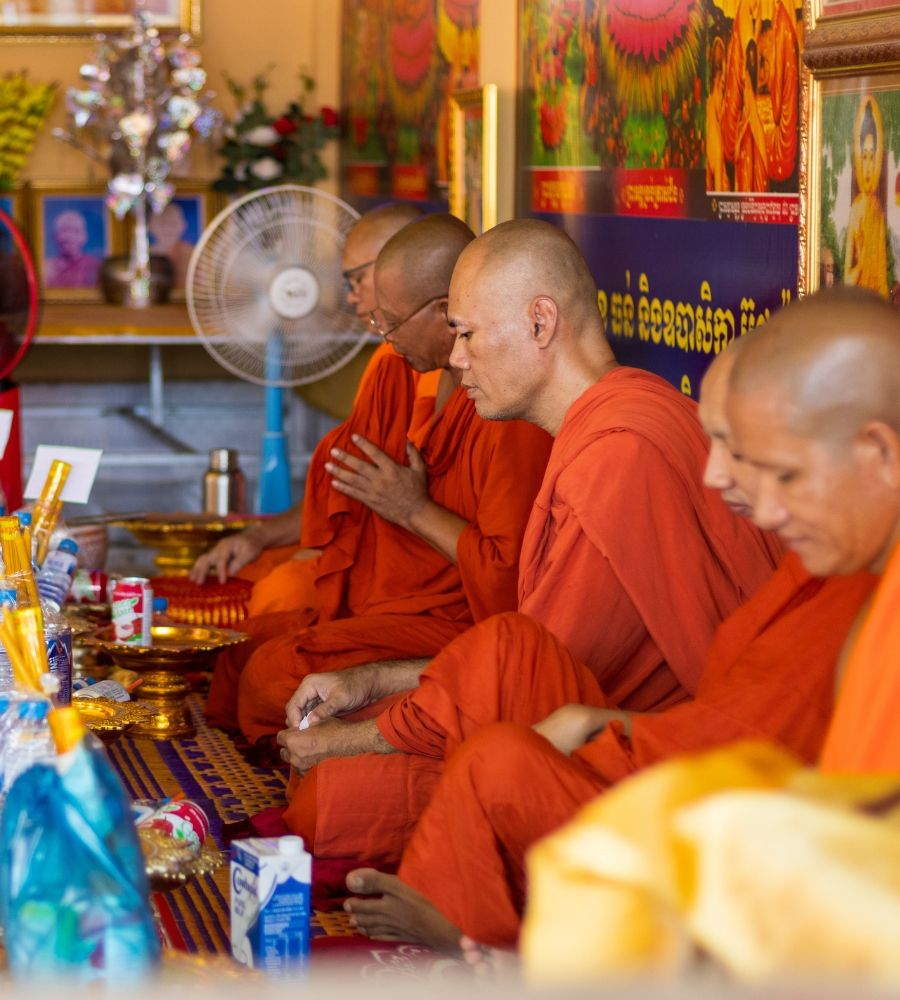
Buddhism is not just the official religion of Cambodia. It is the organising framework of daily life. The local temple, or wat, sits at the centre of community life in every town and village across the country. Young men traditionally spend time as monks, sometimes only for a few weeks or months, as a form of merit-making and spiritual education. The monks you see walking through Siem Reap in the early morning with their alms bowls are not a tourist attraction. They are doing what Cambodians have done every morning for centuries. Watching that procession while the rest of the city is still waking up is one of the quieter and more grounding things you can do here.
There has never been a McDonald’s in Cambodia
Cambodia is one of the very few countries in the world that has never had a McDonald’s. Local food culture, the dominance of street food, and the economics of the market have kept the major international fast food chains largely out of the country. This is widely considered a good thing by most people who have eaten in Cambodia.
Cambodia is one of the most LGBTQ-friendly countries in Asia
Cambodia has never criminalised homosexuality in its history. There is a visible LGBTQ scene in both Phnom Penh and Siem Reap. King Norodom Sihamoni is reported to support the legalisation of same-sex marriage. By the standards of the region, Cambodia is notably open and tolerant on this front.